This chapter presents the technical specifications required for the acquisition of Isuzu Electric garbage trucks and loaders. It is presented in two sections, the first section contains the requirements associated with trucks, both compactors and trucks with loading platforms, and a second section contains the requirements associated with loaders.
Section 1. Requirements associated with Isuzu electric garbage trucks
Below are the requirements and technical characteristics of the compactor trucks, the cargo truck and the services associated with their supply.
3.1.1. General Description
The acquisition of a fleet of four (4) one hundred percent (100%) electric trucks powered by Lithium Ferro Phosphate batteries, new, with a single axle and a rear-loading compactor box.
The total length of the truck, including the compactor box, must be a maximum of seven meters (7.0 m).
The trucks will be used for the collection and transportation of solid waste from Ciudad Colonial in the National District of Santo Domingo de Guzmán. The required daily autonomy is 60 km, which must be obtained with a single recharge lasting no more than 3 hours.
Compacting boxes must have a minimum load capacity of 2.1 tons of urban solid waste, with a rear-loading lifting system (lifter) for 1,100-liter plastic containers. The compaction cycle of the compacting box must not exceed 25 seconds.
Considering that between 50% and 65% of the waste will be organic, the truck must contain a leachate tank.
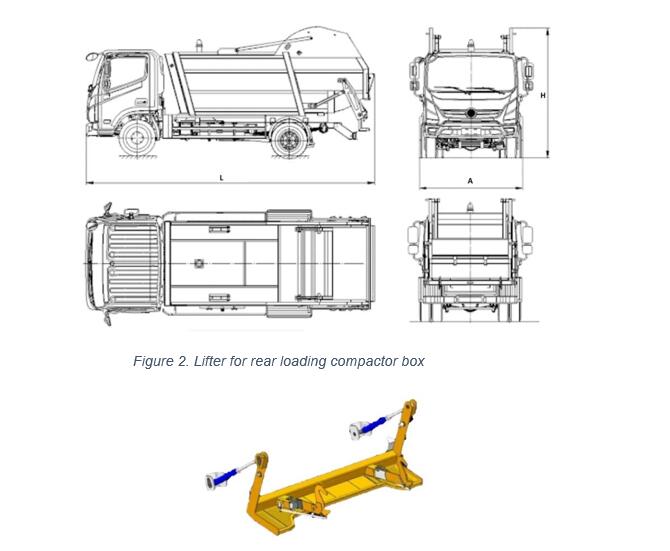
The Bidder shall issue and deliver to MITUR the technical sheets containing the specifications and general characteristics of the trucks and each of their components and equipment that will be used to collect solid waste from the Colonial City described in this specification, in addition to the plans showing the general dimensions (width, length, height), shape, location, views (front, rear, plan and elevations), the compactor box and the lifter, the seats in the cabin, and the battery system that will supply sufficient energy for its operation. The dimensions of the truck must be presented as a single measurement that considers both the truck and the compactor box.

The operating and climatological characteristics are presented below:
a. In a typical work day the vehicle operates approximately 4.5 h and travels 23 km. In each work day the vehicle performs two (2) operating cycles, where each cycle involves the movement of the vehicle from the operating site to the transfer station to eject/dispose of the waste. In each cycle the vehicle compacts approximately 19 times and loads approximately 2.1 tons of waste. In total, in each work day the vehicle loads 4.2 tons, compacts 38 times and ejects 2 times.
a. The distance from the parking site to the operation site is 2 km with an average speed of 30 km/h, and the distance from the operation site to the transfer station where the waste is ejected is 3 km with an average speed of 30 km/
h. In this way, 43% of the total journey (10 km) is made at the operation site with an average speed of 15 km/h.
b. In summary, the following phases are carried out in a work day:
c. Although the operation has a transfer station relatively close to Ciudad Colonial, the desired minimum autonomy considers the case where the electric truck must transport and dispose of waste directly at the Duquesa landfill,
which would add a total of 32 kilometers to the 23 km indicated in the table above. Thus, considering a safety percentage of 10%, the minimum required autonomy of 60 km per charge is determined during the battery warranty
period.

a. Three of the vehicles will have two shifts that can extend up to 6 hours of work each. The collection frequency is six (6) days a week for the 3 vehicles, on the seventh day only two vehicles will work. The fourth vehicle will be in stock for contingency or replacement
of any of the three previous ones when they require preventive or corrective maintenance or presentation of a mechanical or electrical failure.
b. The minimum capacity of the charger is estimated in order to mitigate the unforeseen event of requiring the truck for a third day. If this is the case, the charger must be able to supply 20% to 100% of the charge to the battery of the electric truck for a maximum duration of 3 hours.
c. The climatic conditions in Ciudad Colonial are predominantly tropical, over the course of the year the temperature generally varies from 20 °C to 32 °C and rarely drops below 18 °C or rises above 33 °C.
d. The topography of the routes is on average flat and the roads are 100% paved.
e. The traction system must allow the trucks to reach a speed of 80 km/h and the ability to overcome slopes of at least 20% at maximum load (full load).
The required range for each work day is 60 km, which must be obtained with a single recharge lasting no more than 3 hours. Although the battery is expected to have a minimum capacity to store 100 kWh, proposals are accepted that support that the battery offered will have the required range considering its degradation during the warranty (60 months at 20% maximum degradation and 96 months at 30% degradation) and the safety percentage required by the manufacturer, approximately 20%. Proposals must present an extended liability plan on the proper disposal of the batteries at the end of their useful life.
Compacting boxes must have a minimum load capacity of 2.1 tons of urban solid waste, with a rear-loading lifting system (lifter) for 1,100-liter plastic containers. On average, the collection speed is 1 ton in 22 minutes.
Considering that between 50% and 65% of the waste is organic, the truck must contain a leachate tank.
In accordance with these technical specifications, the interested bidder must submit a detailed sketch of the specifications of its proposal for trucks and compactor boxes in accordance with the specifications defined by this tender.
The sketch must contain, as a minimum, the following elements:
The Offeror must demonstrate compliance with the provisions of Regulation 100 of the United Nations Economic Commission for Europe (UNECE) on uniform provisions relating to the approval of vehicles in relation to the specific requirements of the group
electric propulsion [2015/ 505]. If the Certification is not available, it must be demonstrated that
compliance with the Certification is achieved by means of the Manufacturing Certificate from the country of origin.
international standard. Other internationally recognized standards are:
• National standard of the People's Republic of China, GB/T 18384-2015: Electrically powered road vehicles - Part 2, Operational safety measures and fault protection and Part 3, Protection of persons from electric shock.
• International Standard ISO 6469: Electrically powered road vehicles. Part 2, protection against faults and electric shock.
• Global Technical Regulation No. 20: Safety of electric vehicles.
It is mandatory that the Supplier summons the Contractor in a timely manner so that the latter can attest the SAT tests in the city of Santo Domingo de Guzmán. Once the SAT tests are satisfactory and the MITUR issues its approval signature for each unit, they may be put into operation.
In order to demonstrate that the fleet to be acquired and the respective chargers comply with the specifications, the Offeror will carry out standardized tests in the purchaser's yards or on controlled routes to ensure that all truck components, batteries and other systems comply with current national and international standards, as well as the requirements set forth in these technical specifications.
At least the following tests are proposed:
• Opening and closing doors
• Operation of all dashboard indicators
• Operation of interior and exterior lights
• Operation of the drive train
• Operation of the braking system
• Operation of service and parking brakes
• Verification of the alignment of the axles of the garbage trucks
• Body tightness tests in rain
• Operation of the body electrical system
• Operation of the entire hydraulic system for the correct operation of the compactor box (compaction and waste discharge system), including the operation of the lifter with containers loaded with waste.
• Operation of the reverse whistle and alarm. •
Autonomy: On-road tests, empty and fully loaded, that meet the technical specifications indicated in section 3.1.2 General Characteristics of the Operation. These tests will be carried out simulating the real conditions of the route and on controlled routes in Santo Domingo de Guzmán. Likewise, an autonomy test will be carried out on the route to the Duquesa landfill without entering it, with an average speed between 60 and 80 km/h on the main avenue.
• Battery charging: Functional testing and verification of specifications for recharging with the different types of chargers. These tests will be carried out with the chargers purchased through this tender and installed in the planned location in the yards as indicated in this SDO.
The Supplier will also allow the Contractor, or whoever it designates, to verify the dynamic behavior of the trucks when empty and with maximum load in the operational interfaces of traction and braking, waste collection and compression, and emergency operations, in addition to ensuring that there is a one hundred percent (100%) reliable verification of the emergency and electrical systems.

3.1.1. FAT and SAT Test Protocols
The plan and procedures for performing all tests shall be in accordance with the requirementsas indicated in this specification. A hard copy and a digital copy (editable format) of each protocol must be provided to the Contractor.
a) Test protocol: The test protocol shall be used as a control document for all tests and shall include the following information:
1. Title of each test with reference to the respective article or number of the article or section of the applied standards
2. Participants in the execution and witnessing of each test 3. Location of the test 4.
Date of issue of each test procedure, test report and/or certification of the test document 5.
Serial number of the unit to be tested
6. Environmental conditions (average temperature and relative humidity).
7. Date and time the test was completed
8. Test result 9. Signature
of the authorized representative of each of the parties involved
b) Test procedure: The Supplier shall develop a detailed procedure for carrying out each test and submit it 20 days in advance for review and prior approval by MITUR. This procedure shall be referenced and adhere to the following standards: ANSI, IEC, IEEE or NEMA, as applicable. In the event that the Contractor does not approve the test procedure, the Supplier shall modify it according to the Contractor's instructions, complying with current regulations as well as technical specifications.
c) Identification of evidence: Each procedure must be identified and numbered individually and in a logical sequence with all its pages numbered. The first page must contain the title, date and name of the persons who prepared, executed and witnessed it.
Based on the results of the protocols previously reviewed and approved by the Contractor, the Supplier may begin the execution of the testing procedures.
d) Reports: Each test report must contain a step-by-step procedure for carrying out the test and must include the following information:
1. Title of the test.
2. Purpose of the test.
3. Place, date and time of start and end.
4. Weather conditions existing at the start and end of the test.
(Ambient temperature °C) % relative humidity and Barometric pressure mmHg.
5. Equipment and instruments with tolerances and calibration data.
6. Test methodology including test start-up with circuit diagrams and test sequence.
7. Test criteria, expected values, including procedures for data evaluation.
1. Requirements for test data including models and formats for record the data.
b) Test Report: The Supplier shall prepare a test report to document the results. Each test report shall be bound in volumes and shall be individually numbered in a logical sequence with all pages numbered. The first page of the report shall contain the title, date and name of the persons who prepared and approved it, including the following information:
1. Results including tables, graphs, photographs and any additional data required to support the test results. The results must include all data and observations recorded during the tests.
2. Description of any failure or modification, including the reason for the failure and any modifications, as well as the names of the persons who approved the modifications.
3. Abbreviations and references.
4. Names and signatures of the participants in the tests.
In the case of FAT tests, these must be carried out and have the expected results before the vehicles leave the production site.
Note: It is acknowledged that the autonomy stated in the documents may vary during testing. In any case, the product will be accepted as long as it meets the minimum autonomy standards required in these Technical Specifications.
3.1.1. Overview
The acquisition of one (1) one hundred percent (100%) electric truck powered by a new Lithium Ferro Phosphate battery, with a single axle and electric motor with a load capacity of two point five to
Three (3) tons to be used for the transportation of minor equipment such as 1,100 L solid waste containers (empty), pressure washers and 1,000 L isotanks. The truck must have a retractable hydraulic platform for loading containers and washing equipment for public areas located in the rear of the truck.
The total length of the truck, including the platform, must not exceed six metres (6.0 m). The autonomy required for each working day is a minimum of 100 km, which must be obtained with a single recharge lasting no more than 3 hours.
The Offeror shall issue and deliver to the Contractor the technical sheets containing the specifications and general characteristics of the truck and each of its components and equipment that will be used for the transportation of 1,100 L containers (empty), equipment and tools for washing public areas in
Ciudad Colonial described in this specification, in addition to the plans showing the general dimensions (width, length, height), shape, location, views (front, rear, plan and elevations), the platform, the seats in the cabin, and the battery system that will supply sufficient energy for its operation. The dimensions of the truck mustpresented as a single measure that considers both the truck and the loading platform.

The operating and climatological characteristics are presented below:
a) Vehicle travel speeds during operation are 40 to 60 km/h
b) The climatic conditions in Ciudad Colonial are predominantly tropical, during the course of the year, the temperature generally varies from 20 °C to 32 °C and rarely drops below 18 °C or rises above 33 °C.
c) The topography of the routes is on average flat and the roads to travel are 100% paved.
d) The traction system must allow the truck to reach a speed of 80 km/h and the ability to overcome slopes of at least 20% at maximum load (full load).
The required range for each work day is 100 km, which must be obtained with a single charge lasting no more than 3 hours. Although the battery is expected to have a minimum capacity to store 100 kWh, proposals are accepted that support that the battery offered will have the required range considering its degradation during the warranty (60 months at 20% maximum degradation). Proposals must present an extended liability plan on the proper disposal of the batteries at the end of their useful life.
The truck to be offered must be a flatbed type with the capacity to safely transport between
2.5 and 3 tons of small equipment and waste containers. The flatbed must be able to safely transport 6 containers of 1,100 liters, as shown in the figure below.
3.1.1. Manufacturing and Testing
a) Manufacturing
The truck will be manufactured in accordance with the sketch and specifications of the proposals that comply with this tender. The purchasing authority will have the capacity to supervise the manufacturing or assembly within or outside the Dominican Republic. Technicians designated by the Buyer may travel to the construction site, with 3 days' notice, to review the construction process and/or the FAT tests of the trucks and the quality processes. Alternatively, this may be done remotely, to be coordinated with the Supplier, who in any case must remain in constant communication with the MITUR and notify it in a timely manner prior to carrying out any control test.
b) Uniformity of the Series.
The Bidder shall expressly state that, in the series of vehicles awarded, the Manufacturer shall not modify the technical characteristics of any of them without the express consent of the Contractor, and that all of them must be absolutely identical in terms of both the chassis/frame and body components, unless otherwise expressly indicated by the Contractor.
c) Factory testing (FAT)
The Bidders will define, in accordance with their internal standards and applicable national and international norms and practices, the standardized tests to which the purchased goods will be subjected at the manufacturing site. These tests will serve to demonstrate that the electric truck complies with the requirements specified in this tender.
The Supplier shall be obliged to submit to the Contractor the approved FAT test protocols, through which it shall be verified that the supplied unit is functioning correctly in an integral manner, in accordance with the specifications in this tender.
The minimum tests to be carried out at the factory, in addition to compliance with the general specifications described in these technical specifications, will be carried out to ensure that all truck components, batteries and other systems comply with current national and international standards and are, at a minimum, the following:
• Opening and closing doors
• Operation of all dashboard indicators
• Operation of interior and exterior lights
• Operation of the drive train
• Operation of the braking system
• Operation of service and parking brakes
• Checking the alignment of the truck axles
• Body tightness tests in rain
• Operation of the body electrical system
• Whistle and reverse alarm operation
• Autonomy: tests that meet the technical specifications indicated in section 3.2.2 General Operation Characteristics; i.e. a test of autonomy, within the manufacturer's facilities or on its test circuit. The tests must demonstrate the average energy consumption of the vehicle at a speed of approximately 19 km/h, at 60% vehicle load, making stops every
300 m to simulate traffic lights and stop signs. The test time, distance travelled and energy consumption during the test must be indicated.
• Testing of battery fast and slow charging times and charging temperature.
The truck will be dispatched from the production plant to the Dominican Republic only once the FAT tests have been validated by the Contractor.
a) Purchaser's tests (SAT)
It is mandatory that the Supplier summons the Contractor in a timely manner so that the latter can attest the SAT tests in Santo Domingo de Guzmán. Once the SAT tests are satisfactory and the Contractor issues its approval signature for each unit, they may be put into commercial operation.
In order to demonstrate that the truck to be acquired and the respective charger comply with the specifications, the Offeror will carry out standardized tests at the purchaser's yards or on controlled routes to ensure that all truck components, batteries and other systems comply with current national and international standards, as well as the requirements set forth in these technical specifications. The tests will be carried out in the presence of a representative of the Offeror and the personnel designated by the Contracting Party.
At least the following tests are proposed:
• Opening and closing doors
• Operation of all dashboard indicators
• Operation of interior and exterior lights
• Operation of the drive train
• Operation of the braking system
• Operation of service and parking brakes
• Checking the alignment of the truck axles
• Body tightness tests in rain
• Operation of the body electrical system
• Whistle and reverse alarm operation
• Autonomy: On-road tests, empty and fully loaded, that meet the technical specifications indicated in section 3.2.2 General Characteristics of the Operation. In particular, an autonomy test will be carried out. These tests will be carried out simulating the real conditions of the commercial route and on controlled routes in Santo Domingo de Guzmán.
Battery charging: Functional test and verification of specifications for recharging with chargers.
• Whistle and reverse alarm operation
• Autonomy: On-road tests, empty and fully loaded, that meet the technical specifications indicated in section 3.2.2 General Characteristics of the Operation. These tests will be carried out simulating the real conditions of the route and on controlled routes in Santo Domingo de Guzmán. Likewise, an autonomy test will be carried out on the route to the Duquesa landfill without entering it, with an average speed between 60 and 80 km/h on the main avenue.
• Battery charging: Functional test and verification of specifications for recharging with the different types of chargers. These tests will be carried out with the chargers acquired through this tender and installed in the planned location in the yards according to
as indicated in this SDO
The Supplier will also allow the Contractor to check the dynamic behavior of the truck when empty and with maximum load in the traction and braking operational interfaces, in addition to a one hundred percent (100%) reliable check of the emergency and electrical systems.
3.1.1. FAT and SAT Test Protocols
The plan and procedures for performing all tests shall be in accordance with the requirements set out in this specification. A hard copy and a digital copy (editable format) of each protocol shall be provided to the Contractor and its designee.
a) Test protocol: The test protocol shall be used as a control document for all tests and shall include the following information:
1. Title of each test with reference to the respective article or number of the article or section of the applied standards.
2. Participants in the execution and witnessing of each test.
3. Location of the test.
4. Date of issue of each test procedure, test report and/or certification of the proof document.
5. Serial number of the unit to be tested
6. Environmental conditions (average temperature and relative humidity).
7. Date and time the test was completed.
8. Test result 9. Signature
of the authorized representative of the parties involved
b) Test procedure: The Supplier shall develop a detailed procedure for carrying out each test and submit it 20 days in advance for review and prior approval by MITUR. This procedure shall be referenced and adhere to the following standards: ANSI, IEC, IEEE or NEMA, as applicable. In the event that the Contractor does not approve the test procedure, the Supplier shall modify it according to MITUR's instructions, complying with current regulations as well as technical specifications.
a) Identification of evidence: Each procedure must be identified and numbered individually and in a logical sequence with all its pages numbered. The first page must contain the title, date and name of the persons who prepared, executed and witnessed it.
Based on the results of the protocols previously reviewed and approved by the Contractor, the Supplier may begin the execution of the testing procedures.
b) Reports: Each test report must contain a step-by-step procedure for carrying out the test and must include the following information:
1. Title of the test.
2. Purpose of the test.
3. Place, date and time of start and end.
4. Weather conditions existing at the start and end of the test.
(Ambient temperature °C) % relative humidity and Barometric pressure mmHg.
5. Equipment and instruments with tolerances and calibration data.
6. Test methodology including test start-up with circuit diagrams and test sequence.
7. Test criteria, expected values, including procedures for data evaluation.
8. Requirements for test data including models and formats for record the data.
c) Test Report: The Supplier shall prepare a test report to document the results. Each test report shall be bound in volumes and shall be individually numbered in a logical sequence with all pages numbered. The first page of the report shall contain the title, date and name of the persons who prepared and approved it, including the following information:
1. Results including tables, graphs, photographs and any additional data required to support the test results. The results must include all data and observations recorded during the tests.
2. Description of any failure or modification, including the reason for the failure
and its modifications, as well as the names of the persons who approved it. the modifications.
3. Abbreviations and references.
4. Names and signatures of the participants in the tests.
In the case of FAT tests, these must be carried out and have the expected results before the vehicles leave the production site.
Note: It is recognized that the autonomy offered in the documents may vary during testing.
In any case, the product will be accepted as long as it meets the minimum autonomy standards required in these Technical Specifications.
Services Associated with Truck Supply
The Offeror must establish that all licenses and patents of the buses, physical or software parts or components, diagnostic tools and motorization equipment of the SoC (Stat of Charge) of the traction batteries are one hundred percent (100%) guaranteed without prejudice to the Contractor during the guaranteed useful life of the buses.
A copy of the certifications and approvals that the buses offered have regarding their frame, body, engine, batteries, useful power available on the tractor axle, noise emission level, and electromagnetic compatibility must also be attached.
It will be stipulated that if any use of software is necessary, this will be free of charge to the Contractor.
The Bidders will establish and deliver the required maintenance program for the trucks and compactors, taking into account a useful life of the trucks of ten (10) years, with an annual mileage of each vehicle of twenty thousand kilometers (20,000 km) and a daily operation of ten (10) hours at a commercial speed of the order of nineteen (19
km/h).
The maintenance program will contain all the components and subsystems of the truck.
complete. This program will detail all the operations to be performed, specifying for each of them the inspection and/or replacement periods, and defining both the necessary supplies and spare parts, as well as the labor required for each intervention. Likewise, the total time required to carry out the maintenance program activities that involve putting the trucks out of operation will be estimated. The maintenance program must be delivered in Spanish.
In addition, for a period of one (1) year/twelve (12) calendar months, starting from the satisfactory delivery of the vehicles, the Supplier will make available to the Contractor, or whoever it designates, a technical team which will be responsible for the execution of the preventive maintenance program for both the vehicles and the compactor boxes.
Bidders must include in their bids an estimate of the total cost associated with the provision of the maintenance service for the indicated period, which must include: the costs associated with the salary of the technical team, the consumables and the parts that must be replaced to guarantee the correct operation of the vehicle. In the event that corrective maintenance is required, the technical team must provide its knowledge and guide the Contractor, or whoever it designates, in order to guarantee that the correction is carried out properly. All required parts and consumables must be supplied in accordance with the requirements established in the following section on "Availability and supply of supplies and spare parts."
The Offeror will determine the local distributor, with offices and warehouses in Santo Domingo de Guzmán, Dominican Republic, that will carry out the availability of the inputs or spare parts. For the inputs or “critical spare parts”, these must be available within a maximum period of ninety-six (96) hours from the time the order is placed. “Critical spare parts” shall be understood as those that, in the event of failure or absence, cause the immobilization of the vehicle or unavailability of the charger. The Offerors must provide with their Offer a list of the inputs or spare parts considered critical for the proposed bus and charger models. For the rest of the inputs and spare parts, the Supplier must supply them within a period not exceeding fifteen (15) calendar days.
This availability of all kinds of supplies and spare parts will extend throughout the useful life of the trucks, facilitating and updating (at least annually) the updated reference catalogues of all the sets that comprise them.
The Supplier shall guarantee the supply of inputs and spare parts or components of original assemblies of other brands associated with the chassis, bodywork and compactor box of the supplied vehicles, throughout their useful life, supporting the granting of guarantees and updating of technical documentation, in the same way as for the components of its own brand.
The commitment to supply and availability of spare parts may be made by the Offerors themselves or through the authorised distributor designated in their offer, with the Supplier being jointly responsible with said distributor. It shall also guarantee the supply through the manufacturers of the components of the large elements integrated into the trucks, such as batteries, signalling components, etc., having, where applicable, the corresponding rates.
To this end, the bidder will include in its offer the table of critical inputs or spare parts, indicating their reference price.
The Bidders undertake to provide the purchaser, as part of their technical-economic proposal, with practical and theoretical training courses on the handling of electric trucks, their operation, maintenance, general knowledge of all trucks and charging equipment.
The training of truck drivers will be face-to-face, lasting a minimum of twenty (20) hours spread over sessions for a minimum of three (3) days, for at least ten (10)
people at the operating site, in Santo Domingo de Guzmán, Dominican Republic.
This training consists of teaching drivers and operators the optimal way to drive and operate the compacting boxes of this type of vehicle. In addition, it teaches them the recommended use of the vehicles according to their manufacturer and the handling of the recharging equipment.
Likewise, training must be provided to the collection assistants in the correct operation of the compacting box. This activity must be in person and practical, lasting at least eight (8) hours for eighteen (18) people.
Training materials must be delivered in physical and electronic documents prior to training sessions.
3.1.1. Training for Technical Personnel
This training is aimed at mechanical personnel in charge of routine maintenance of both the vehicle and the compactors, by the operator. The training for maintenance personnel will be face-to-face, with a duration of at least twenty (20) hours spread over sessions for a minimum of three (3) days, for at least ten (10) people at the operating site, in Santo Domingo de Guzmán, Dominican Republic.
The Offeror will also provide, for a period of no less than ninety (90) calendar days, an online consultation system that allows for resolving doubts and clarifications regarding the activity of drivers and maintenance personnel.
It will also provide documents in Spanish detailing the truck's operation and preventive and corrective maintenance manual.
3.2. Charging Systems
The supply and commissioning of two (02) DC electric chargers, each with two connectors with a total charging capacity of 100kW. The chargers must be delivered installed and each one must have sufficient capacity to fully recharge two trucks at the same time in a maximum of 3 hours.
For the installation of the chargers, the bidder may assume that the necessary electrical infrastructure will be available, including the transformers. In addition, the proposal may assume that the connection distance to the chargers is 10 meters.
The Bidder must include the technical specifications of the chargers and the certifications they have, including their plans and connection diagrams.
In accordance with these terms of reference, the Offerors shall submit a detailed sketch of the specifications of their proposal for the loaders in accordance with the specifications defined by this tender.
The acquisition and installation of two (2) DC chargers is proposed, each with two with two connectors, intended for charging the batteries of the 4 electric trucks in the yard.
Partner with a local company to ensure that all aspects of integration and operation are fully compliant with local standards and good practices.
Additionally, chargers must be able to provide the optimal charging profile as specified by the battery manufacturer.
The loading equipment shall operate continuously, without degradation of performance or safety, under typical ambient conditions in predominantly tropical Colonial City. Over the course of the year, the temperature typically varies from 20°C to 32°C (68°F to 90°F) and is rarely below 18°C (65°F) or above 33°C (90°F). Relative humidity is 5% to 95%).
Bids must include the installation of the chargers. Quotations may assume that the necessary electrical infrastructure, including the transformer, is in place. The connection distance for the chargers is 10 m. The proposal must include all
installation costs deemed necessary from the charger to the transformer (the cost of the transformer or the cost of civil works should not be included).
The bidder is free to submit the most cost-efficient offer as long as it is supported by the most recent regulations and codes for electrical installations in the Dominican Republic.
The Supplier will be informed of the details of the site to be installed and will be responsible for working directly with the personnel responsible for the yard to ensure that all aspects of integration and operation are fully compliant with local standards and best practices. Based on the parameters of the loading yard, the Supplier may update the cost of the installation, which must be validated by representatives of the Contractor.
3.4.3. Technical Specifications of Chargers
Chargers must meet the technical specifications listed in the table below. Bidders must copy this table exactly and create an additional column to report how the equipment offered meets the requirement.
Shippers must have the ability to communicate between the truck and the shipper.
In addition, they must be able to collect data through a charging management platform relating to the status of the charging equipment (available, faulty, charging, connected, disconnected, etc.), the power supplied (power supplied individually and collectively, number of charging sessions, time and power delivered in each session, start and end date and time of each session), and any other event that could be reported by the equipment, such as the percentage of charge of the vehicle connected at the start and end of the charging session.
The equipment must comply with one of the international standards and regulations mentioned below or with a certificate from the country of origin on compliance with the international standard: IEC 61851, ISO 15118, GB/T 27930. In turn, the communication protocol of the chargers must be OCPP (Open Charge Point Protocol) version 1.6 or later or other software with similar characteristics.
Must meet the following:
• Complies with the requirements for protection against electric shock defined in EC 61851-1 and IEC 61851-23, paragraph 7 or those established in GB/T 20234 standards
• Includes RCD residual current device, with characteristics equivalent to at least type A defined in IEC 61088-1 or IEC 61009-1 / IEC/TR 60755
• Includes residual current device RCD <= 30 mA
Basic verification functions of IEC 61851-23 or GBT/T 20234.
3.4.3. Standard Verifications
• Verification that the vehicle is correctly connected • Checking the continuity of the grounding conductor • Energizing the system • De-energizing
the system using the
identification card or the emergency stop button
• Supply must be for the electric vehicle • Current and voltage measurement •
Coupler retention/disengagement • Coupler locking • Compatibility
assessment
• Insulation verification
• Overvoltage protection on the battery • Voltage verification
at the vehicle connector • Control circuit integrity • Short circuit test
• User shutdown • Overload protection for parallel conductors • Temporary
overvoltage protection • Others:
specify • Allow management and monitoring of the status, consumption, charging time, user identification among others, locally
or remotely through
specified communication protocols
3.4.4. Tests and Trials
• Complies with the tests described in IEC 61851-1 and IEC 61851-23, UL 2594,
UK 2231, UL 991, UL 1998, UL 2251 and GBT/T 20234
3.4.5. Marking
• Number of phases
• Environmental stress of the source •
Maximum and minimum load rating • Reason for the load • Trademark or
name of the producer or distributor in the Dominican Republic
• Power consumed
Power factor • Harmonic distortion
• IEC 61851 -1 or indicate its equivalent
• IEC 61851-23, 61851-24 or Indicate its equivalent
• GB/T 20234 AC or equivalent
• Present certificates of electrical products in accordance with the Republic standard Dominican applicable
3.1.1. Authorization of Licenses and Patents
The Offeror must establish that all licenses and patents of the chargers, parts or physical or software components are 100% guaranteed without prejudice to the Contractor during the guaranteed useful life term. If any use of software is necessary, this will be free of charge to the Contractor.
3.1.2. Preventive and Corrective Maintenance
The Bidder will establish the maintenance program required for the chargers, taking into account a useful life of eight (8) years.
The maintenance program will contain all the components of the charger. This program will detail all the operations to be carried out, specifying for each of them the inspection and/or replacement periods, and defining both the necessary supplies and spare parts, as well as the labor required for each intervention. Likewise, the total time required to carry out the activities of the maintenance program that involve putting the charger out of operation will be estimated.
In addition, for a period of one (1) year / twelve (12) calendar months, starting from the satisfactory delivery of the installed chargers, the offeror will make available to the Contractor, or whoever it designates, a technical team which will be responsible for the execution of the preventive maintenance program for both the chargers and the electrical and electronic system between the charger and the transformation substation. The offeror must include in its offer the total cost associated with the provision of the service, which must include the costs associated with the salary of the technical team, the consumables and the parts that must be replaced to guarantee the correct operation of the recharging system. In the event that corrective maintenance is required, the technical team must provide its knowledge and guide the Contractor, or whoever it
designates, and its technicians in order to guarantee that the correct operation of the recharging system is carried out.
correction is carried out appropriately.
The Offeror undertakes to provide the purchaser, as part of its technical-economic proposal, practical and theoretical training courses on the handling of the chargers, their operation, maintenance concepts and general knowledge.
This training is aimed at mechanical personnel in charge of the operation and maintenance of the loaders. The training for this personnel will be at least ten (10) hours for at least 10 people.
3.5.4. Installation
The Offeror undertakes to install and put into operation the chargers purchased in the locations indicated in the corresponding contract in the city of Santo Domingo de Guzmán, Dominican Republic. To this end, the Offeror will include a detail of the installation design as well as a detail of the minimum distances of its elements, so that the Contractor can make the necessary adjustments.
3.1. Warranties and After-Sales Service
Trucks and loaders must have a clearly stated factory warranty, as well as their performance conditions within the metropolitan area of Santo Domingo de Guzmán, Dominican Republic, through the determination and identification of a local representative.
This means that interested bidders must define the workshops and service centers, available technology, spare parts with delivery times, specialized personnel, service times and a cost catalog for maintenance services in the Dominican Republic (local representative).The maximum times for spare parts availability, fault diagnosis and fault repair will be taken into account. The availability of spare parts cannot be greater than ninety-six (96) hours.