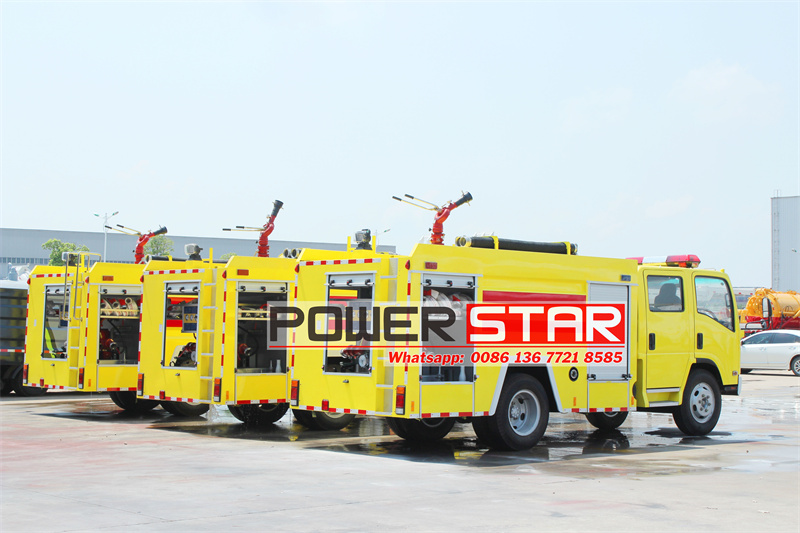
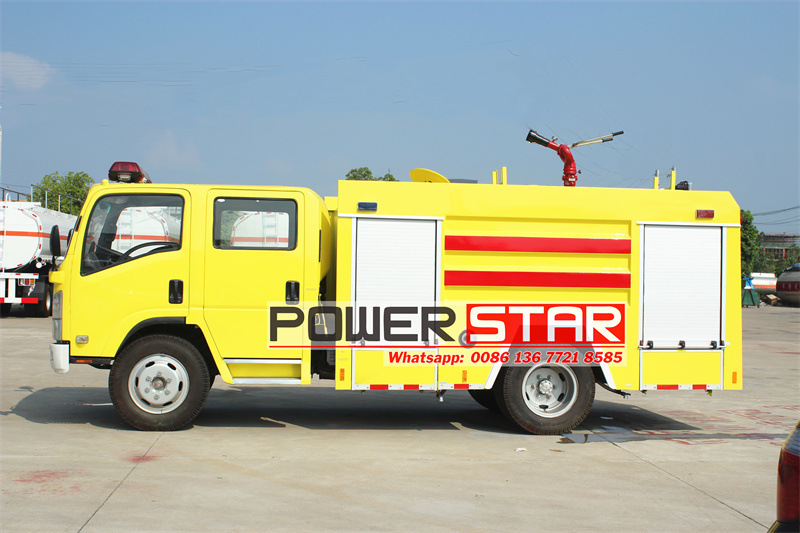
In the field of modern firefighting equipment, the performance measurement of Isuzu fire fighting truck is the core link to ensure rescue efficiency and safety. The performance measurement of water cannon and foam cannon is not only an important means of technical evaluation, but also a key path to improve the overall quality of firefighting equipment.
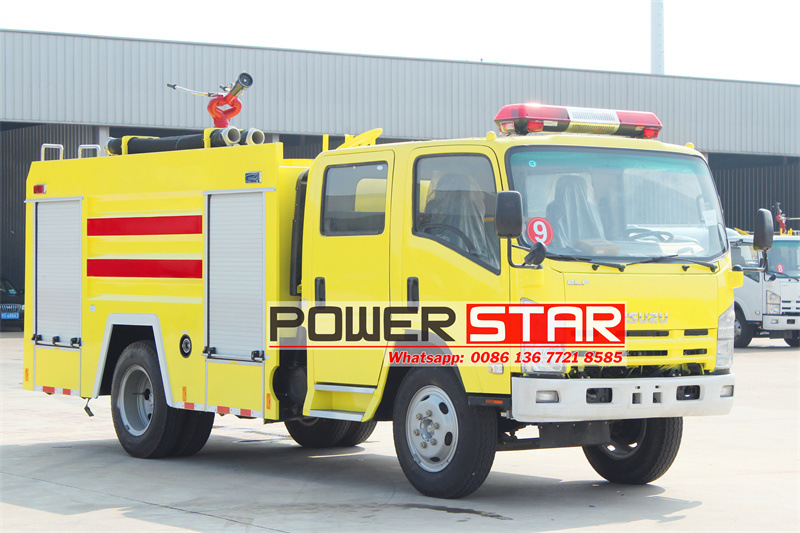
There are two strategic significances for performance measurement:
1. Accurate evaluation of firefighting effectiveness: Performance measurement provides a scientific and quantitative basis for the actual combat capability of Isuzu fire water truck. By systematically testing the range, pressure, flow and other key indicators of water cannon and foam cannon, we can accurately evaluate their actual role in different disaster scenarios. For example, the range measurement not only focuses on the maximum distance, but also on stability and accuracy, which directly affects the safe combat radius of firefighters.
2. Safety performance guarantee: Behind each performance indicator, there is a deep concern for the life safety of firefighters. The precise control of pressure and flow means that more stable and controllable firefighting conditions can be provided in complex disasters, minimizing the risk of secondary injuries.
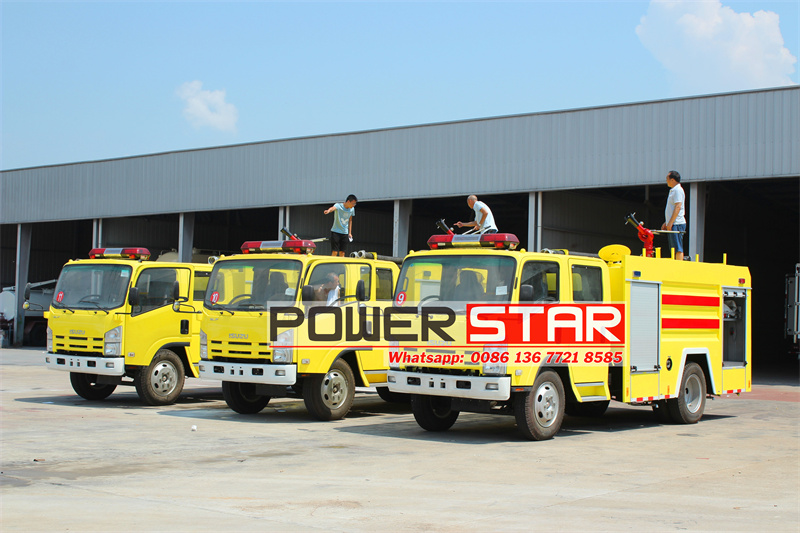
Let's take a look at the measurement process and content of Isuzu fire fighting truck water cannon:
A. Determination of the range of water cannon and foam cannon:
1.Test conditions
The test site should be flat, with sufficient length and width. The fire truck should be parked at a suitable position on the site, and the gun elevation angle should be 30°.
±2°. Taking the intersection of the plumb line passing the muzzle and the ground as the origin, measure the range in the downwind direction.
2. Test operation
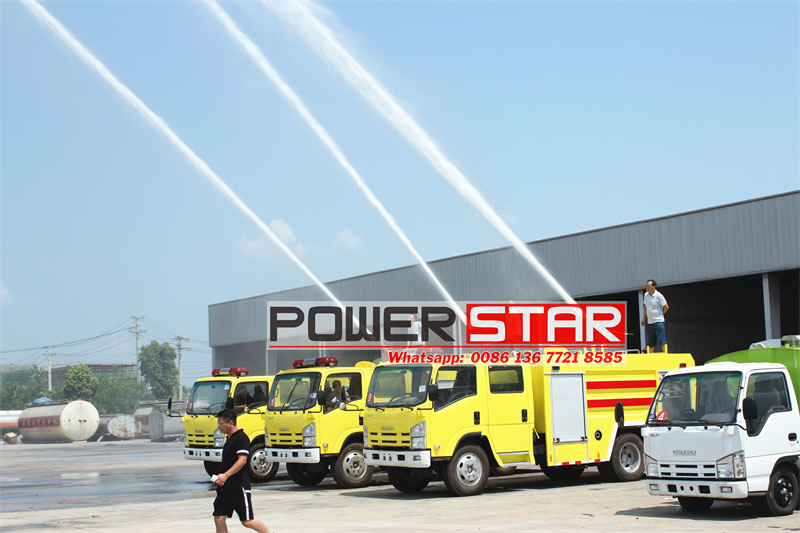
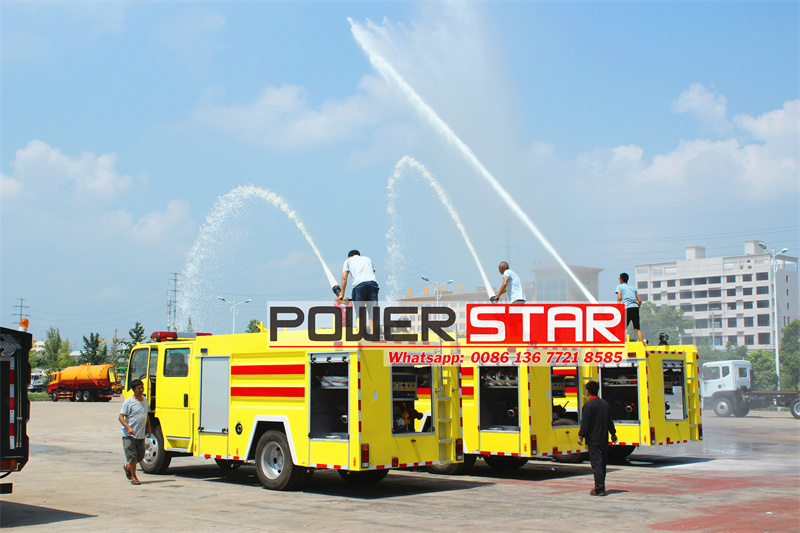
During the test, the wind speed should be less than 2m/s. Start the fire pump. After the inlet pressure of the gun reaches the rated injection pressure and the sprayed water or foam stabilizes, spray continuously for 30 seconds without changing the elevation angle. Use a stopwatch to measure the farthest point where the medium is continuously dropped for no less than 10 seconds. The distance from this point to the origin is the range of the gun.
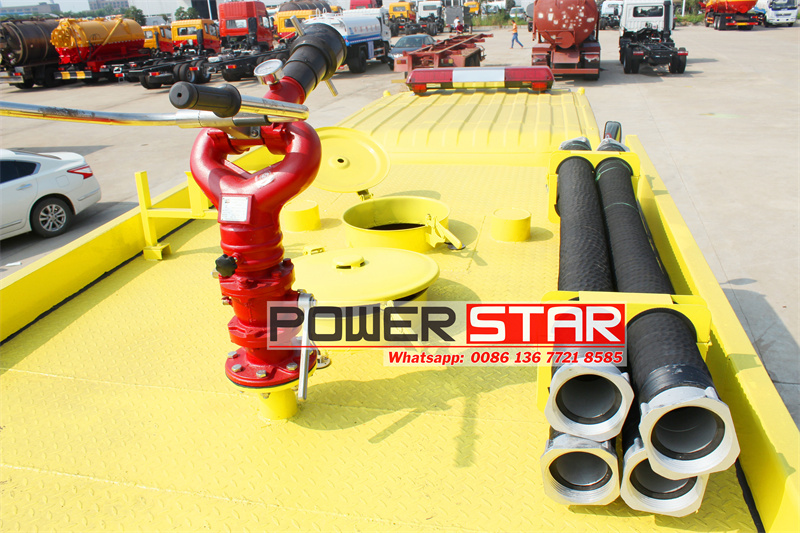
B. Measurement of fire truck outlet water pressure and flow rate:
1.Test conditions
The test site should be flat, with sufficient length and width. The fire truck should be parked at a suitable position on the site, and the gun elevation angle should be 30°.
±2°. Taking the intersection of the plumb line passing the muzzle and the ground as the origin, measure the range in the downwind direction.
2. Test operation
Start the fire truck, adjust the speed of the pump and the opening of the outlet valve so that the water pressure and flow rate of the fire truck reach the values specified in 4.2.9; after the operation is stable, read the water pressure and flow values.
C. Determination of mixing ratio:
Taking advantage of the characteristics of different refractive indexes of foam mixtures of different concentrations, a refractometer is used to measure the mixing ratio.
First, make a calibration curve, use a dropper to take out the foam liquid from the foam liquid tank of the fire truck, and drop 3mL, 6mL, and 9mL foam liquid into three 100mL measuring cylinders respectively; then add the water in the water tank of the semi-fire truck into each Set the measuring cylinder to 100 mL, mix thoroughly to make foam mixtures with standard concentrations of 3%, 6%, and 9%. Read the scales on the refractometer, and make the relationship between the refractometer scales and the concentration of the foam mixture on the graph paper. Calibration curve.
Use the foam mixture precipitated by the liquid elution time test as a sample, read the scale number on the refractometer, and find the mixing ratio of the sample from the calibration curve.
D. Determination of foaming multiple and 25% liquid drainage time:
Place the foam collector and foam liquid analyzer near the center where the foam is expected to fall. The foam cannon sprays in other directions first, and then turns to the foam collector after the rated injection pressure is reached and stabilized. Start timing when the liquid drainage measuring device flows into the foam, which is used as the starting time of the liquid drainage time test; stop spraying after it is filled with foam, scrape off the excess foam on the top with a scraper, wipe the outer surface, and the sampling is completed.
E. Determination of foaming multiple:
Weigh the mass of the liquid analyzer filled with foam, and use the equation to calculate the foaming multiple:
In the formula: N——foaming multiple;
Ve - the volume of the foam leakage measuring device, cm3;
W´e——The total mass of the foam liquid analyzer when it is filled with foam, g;
We——the mass of the foam leakage measuring device, g;
d——The density of the mixed liquid, take d=1g/m3.
Take the arithmetic mean of the test results of the two specimens.
F. Determination of 25% liquid drainage time:
Remove the liquid receiving tank below the foam liquid measuring device and place it on the bench scale. Place the foam receiving tank above on the bracket. Pay attention to keep all the liquid that has separated out being injected into the liquid receiving tank. When the mass of the precipitated liquid reaches 25% of the liquid precipitation mass, stop timing and record the 25% liquid precipitation time. Take the arithmetic mean of the test results of the two specimens.
25% liquid drainage mass is calculated according to the formula: where: Wf——25% liquid drainage mass, g.
G. Correction for the influence of test temperature:
The temperature of the water in the foam mixture has a great influence on the foaming multiple and liquid drainage time. Therefore, the temperature of the water during the test should be controlled within the range of 15 to 25°C. The following modifications are made to protein foam fire extinguishing agents:
Foaming multiple - when the water temperature of the mixed solution is greater than 20°C, the foaming multiple will be reduced by 0.1 for every 1.7°C increase; when the mixed solution water temperature is less than 20°C, the foaming multiple will be increased by 0.1 for every 1.7°C decrease.
Liquid separation time - when the water temperature of the mixed liquid is greater than 20℃, the liquid precipitation time increases by 0.1min for every 1.7℃ increase; when the mixed liquid water temperature
If the water temperature is less than 20℃, the liquid separation time will be reduced by 0.1min for every 1.7℃ drop.