An Isuzu refrigerated freezer truck maintains the cold chain by combining a high-performance refrigeration unit, an insulated cargo box, controlled air circulation and temperature monitoring. These systems work together to keep perishable goods within their required temperature range during transportation, helping protect product quality from the loading point to final delivery.
For food distributors, supermarkets, seafood suppliers, pharmaceutical companies and cold-chain logistics operators, maintaining a stable temperature is just as important as choosing a reliable truck chassis. A well-configured Isuzu refrigerated truck is designed to reduce heat entering the cargo compartment, remove unwanted heat and maintain suitable conditions throughout the journey.
But how does the system actually work? The answer involves several components working together rather than the refrigeration unit alone.
An Isuzu refrigerated freezer truck uses a refrigeration cycle to remove heat from the cargo compartment. The refrigeration unit circulates refrigerant through key components, including the compressor, condenser, expansion device and evaporator.
The compressor pressurizes the refrigerant and sends it to the condenser, where heat is released. After passing through the expansion device, the refrigerant enters the evaporator at a lower pressure and temperature. As it absorbs heat from the air inside the cargo box, the compartment becomes cooler. The refrigerant then returns to the compressor and repeats the cycle.
This continuous process helps the truck maintain the selected temperature. Depending on the refrigeration unit and vehicle configuration, an Isuzu freezer truck can be designed for chilled products, frozen food or other temperature-sensitive cargo.
The refrigeration system is only one part of the cold-chain solution. Insulation, door sealing, loading practices and air circulation all influence the actual temperature inside the cargo box.
The refrigeration unit is responsible for removing heat that enters the cargo compartment during transportation. Its capacity should match the box volume, insulation performance, target temperature, outside climate and type of cargo.
For example, a truck transporting chilled vegetables in an urban distribution route may require a different cooling configuration from a vehicle carrying frozen meat over long distances. A unit that is too small may struggle to maintain the set temperature, especially in hot weather or during frequent door openings.
Isuzu refrigerated trucks can be configured with well-known refrigeration brands such as Carrier and Thermo King, depending on the model and customer requirements.
One example is the Isuzu Freezer Van with Thermo King. This model uses a Thermo King RV380 refrigeration unit and an insulated polyurethane foam cargo box. Its published specifications include an approximately 16 m³ cargo volume and a stated minimum compartment temperature of -18°C.
These specifications illustrate how the refrigeration unit and cargo-box design are matched to frozen-goods transportation. The final configuration should always be selected according to the required operating temperature and actual transport conditions.

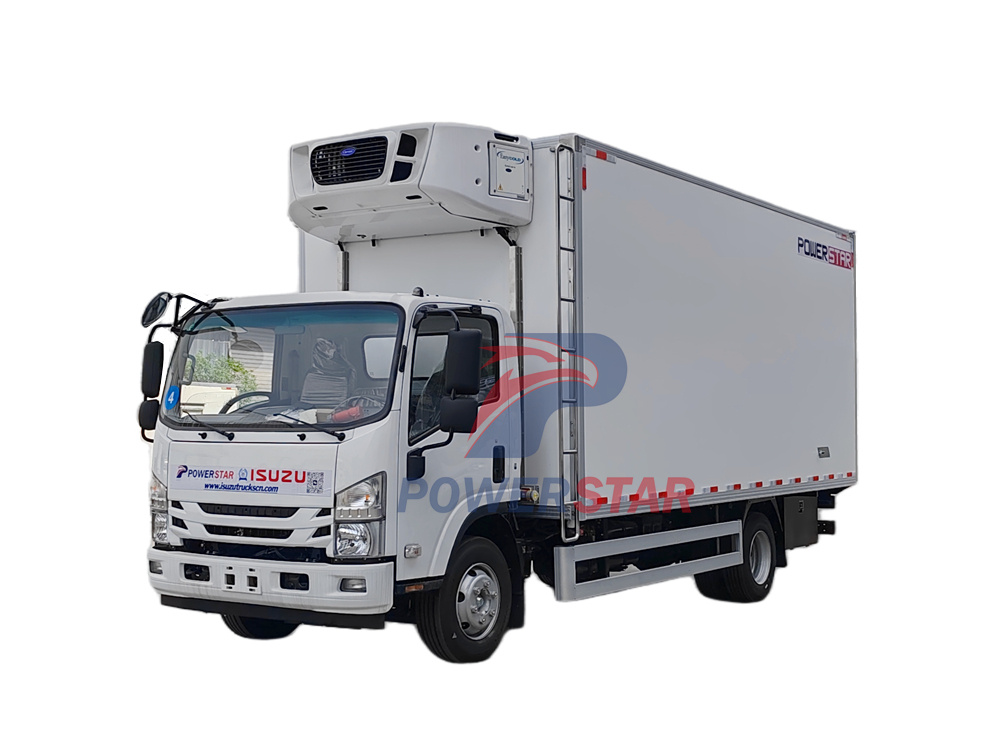
Isuzu refrigerated freezer truck with a roof-mounted refrigeration unit.
Even a powerful refrigeration unit cannot maintain a stable temperature if the cargo box allows too much heat to enter. This is why insulation is one of the most important parts of an Isuzu refrigerated truck.
Most refrigerated bodies use a sandwich-panel structure. Fiberglass or other protective outer and inner skins surround an insulating core, such as polyurethane foam or polystyrene. The insulation layer slows heat transfer between the outside environment and the refrigerated compartment.
The quality of the panel joints, floor, roof, side walls and door seals also matters. Poorly sealed doors or damaged insulation can create thermal leakage, forcing the refrigeration unit to work harder and making temperature control less consistent.
For operators who need a vehicle for frozen meat, seafood or other low-temperature products, the box-body structure should be considered together with the cooling unit. You can explore the Isuzu Meat Freezer Truck range for configurations designed around meat transportation and frozen cargo requirements.
Cold air needs to circulate throughout the cargo compartment. If goods are packed tightly against the evaporator outlet or stacked directly against the walls and ceiling, airflow can become restricted. Some areas may then become colder than others.
A properly designed refrigeration system distributes cooled air through the compartment so that it can reach the cargo more evenly. Drivers and loading teams should leave suitable air channels around the load and avoid blocking the evaporator air outlet or return-air path.
Good loading practices make a noticeable difference:
• Do not block the refrigeration unit's air outlet or return-air inlet.
• Leave appropriate clearance between cargo and the interior walls where the loading design requires it.
• Distribute goods evenly and secure them to prevent movement during driving.
• Use suitable pallets, racks or partitions when required by the cargo type.
• Avoid loading warm products into a compartment that is expected to maintain a frozen temperature without allowing for the additional cooling load.
In other words, refrigeration performance depends not only on the equipment but also on how the vehicle is loaded and operated.
Temperature monitoring allows operators to check whether the cargo compartment is staying within the required range. Depending on the vehicle configuration, the system may include a digital controller, temperature sensors, alarms or remote monitoring functions.
The driver can use the control panel to set the target temperature and check the compartment reading. More advanced configurations may support remote temperature monitoring, allowing fleet managers to review operating conditions during transportation.
For cold-chain operations, monitoring is useful because a single temperature reading at the beginning of a trip does not prove that the cargo remained within range for the entire journey. Temperature records can help operators identify unusual changes, investigate potential problems and improve delivery procedures.
For example, the Isuzu 4 Ton Refrigerated Box Truck is built on an Isuzu 700P chassis and is listed with a Carrier SUPRA 850+ independent refrigeration unit and C400 evaporator. Its published specifications show a temperature setting range of -20°C to +20°C. The product description also lists temperature-control accuracy and remote-monitoring features for the specified configuration.
Isuzu 700P refrigerated box truck for food and temperature-controlled distribution.
A refrigerated truck is designed primarily to maintain the temperature of properly prepared cargo, not necessarily to rapidly freeze or chill a large quantity of warm products. Loading goods at the correct temperature helps reduce the cooling load and makes it easier for the refrigeration system to maintain stable conditions.
Before loading, operators should check that the refrigeration unit is working correctly and pre-cool the cargo compartment when required by the transport procedure. The target temperature should be selected according to the product's handling requirements rather than using the same setting for every type of cargo.
During loading and unloading, keep the doors open only as long as necessary. Frequent or prolonged door openings allow warm, humid air to enter the compartment. In hot climates, this can increase the cooling demand and contribute to temperature fluctuations.
For multi-stop distribution, insulated strip curtains, suitable partitions and an efficient loading sequence can help reduce unnecessary cold-air loss.
Different products have different temperature requirements, cargo volumes and delivery patterns. Choosing the right Isuzu refrigerated truck starts with understanding the goods being transported.
Fresh vegetables and fruit: These products commonly require chilled transportation rather than deep freezing. Ventilation, humidity management and a suitable temperature range are important considerations.
Frozen meat and poultry: Frozen products need a refrigeration system and insulated box designed to maintain the specified sub-zero temperature. The loading temperature and door-opening frequency should also be considered.
Seafood: Seafood transportation may require chilled or frozen conditions depending on the product and handling method. A suitable box-body material, cleanable interior and correctly sized refrigeration unit are important.
Dairy products and beverages: These products generally need a controlled chilled environment. The required temperature should be based on the product specification and applicable food-safety requirements.
Pharmaceutical products: Some medicines and biological products require tightly controlled temperature conditions and documented monitoring. Buyers should specify the exact temperature range, monitoring method, alarm requirements and any applicable regulatory standards before ordering.
For a wider choice of body lengths, refrigeration systems and cargo applications, visit the Isuzu Freezer Trucks product category. Available configurations cover different cold-chain transportation needs, from compact distribution vehicles to larger refrigerated trucks.
When selecting an Isuzu refrigerated freezer truck, buyers should look beyond the chassis and engine specifications. The complete refrigeration system and insulated body determine whether the vehicle is suitable for the intended cold-chain operation.
• Required temperature range: Confirm whether the cargo needs chilled, frozen or multi-temperature transportation.
• Refrigeration capacity: Match the cooling unit to the cargo-box volume, insulation, ambient temperature and loading conditions.
• Insulation material and thickness: Check the panel construction, floor insulation, door sealing and thermal performance.
• Box dimensions and payload: Select a body size that fits the cargo volume while remaining within the vehicle's legal weight limits.
• Airflow design: Confirm that the evaporator and cargo layout allow sufficient air circulation.
• Temperature monitoring: Decide whether a digital controller, data logging, alarms or remote monitoring is needed.
• Service and maintenance: Check the availability of refrigeration-unit servicing, spare parts and technical support in the operating region.
• Local regulations: Confirm vehicle registration, food transport, pharmaceutical transport and temperature-record requirements where applicable.
A suitable truck is not simply the one with the largest refrigeration unit. It is the vehicle whose chassis, cargo box, insulation, cooling capacity and monitoring functions match the actual transport task.
Regular maintenance helps an Isuzu refrigerated truck maintain reliable cooling performance and reduces the risk of unexpected temperature problems.
• Clean the condenser and evaporator according to the manufacturer's maintenance schedule.
• Inspect refrigerant lines, electrical connections and refrigeration-unit components.
• Check door seals, hinges and locking mechanisms for damage or air leakage.
• Inspect the insulated body for cracks, impact damage or moisture penetration.
• Verify temperature sensors and control-panel readings at recommended intervals.
• Keep the cargo compartment clean and remove debris that could obstruct airflow.
• Record maintenance work and investigate repeated temperature alarms or unusual operating patterns.
Maintenance intervals and procedures should follow the refrigeration-unit manufacturer's instructions and the vehicle's service requirements. If the truck is used for food or pharmaceutical transportation, cleaning and temperature-record procedures should also follow the relevant local standards.
An Isuzu refrigerated freezer truck maintains the cold chain through four connected functions: the refrigeration unit removes heat, the insulated cargo box limits heat entering from outside, air circulation distributes cooled air, and temperature monitoring helps operators identify changes during the journey.
However, reliable cold-chain transportation also depends on correct pre-cooling, suitable loading temperatures, limited door-opening time and regular maintenance. Each part of the operation contributes to protecting perishable goods.
For businesses planning to purchase a refrigerated truck, the best starting point is to define the cargo type, target temperature, box volume, delivery distance and operating climate. POWERSTAR can then help match an Isuzu chassis, refrigerated body and cooling unit to the intended application.
How does an Isuzu refrigerated freezer truck keep food cold?
It uses a refrigeration unit to remove heat from the cargo compartment. Insulated panels reduce heat entering from outside, while the evaporator circulates cooled air to help maintain the required temperature.
What temperature can an Isuzu freezer truck maintain?
The available temperature range depends on the refrigeration unit, insulated body and vehicle configuration. For example, the Isuzu 4 Ton refrigerated box truck listed on the POWERSTAR website has a stated setting range of -20°C to +20°C. Buyers should confirm the required operating range for their specific cargo and selected configuration.
What is the difference between a refrigerated truck and a freezer truck?
A refrigerated truck is commonly used for chilled products, while a freezer truck is configured for frozen goods and sub-zero transportation. The distinction depends on the refrigeration unit, insulation and required temperature range rather than the vehicle name alone.
Can an Isuzu refrigerated truck transport frozen meat?
Yes. Isuzu freezer trucks can be configured for frozen meat transportation with a suitable refrigeration unit and insulated cargo box. The required setpoint should follow the product specification and applicable food-safety rules.
Why is insulation important in a refrigerated truck?
Insulation slows heat transfer from the outside environment into the cargo compartment. Good insulation reduces the cooling load on the refrigeration unit and helps the truck maintain a more stable internal temperature.
Does the refrigeration unit need to run during loading and unloading?
Operating procedures vary by vehicle and refrigeration-unit design. In general, keeping doors open for a long time allows warm air to enter. Operators should follow the equipment manufacturer's instructions and their cold-chain loading procedure to limit temperature changes.
Can one Isuzu refrigerated truck carry products requiring different temperatures?
Some vehicles can be configured with insulated partitions and separate temperature zones. Whether this is suitable depends on the refrigeration system, evaporator arrangement, compartment design and the temperature requirements of each product.
How often should an Isuzu refrigerated truck be maintained?
Maintenance should follow the vehicle and refrigeration-unit manufacturers' schedules. Regular checks should include the condenser, evaporator, refrigerant system, electrical components, door seals, insulation and temperature sensors.
Is temperature monitoring necessary for cold-chain transportation?
Temperature monitoring is strongly recommended because it helps operators check whether the cargo compartment remains within the required range. For sensitive food and pharmaceutical products, data logging and alarm functions may also be required by company procedures or local regulations.
How do I choose the right Isuzu refrigerated freezer truck?
Start with the cargo type, required temperature, daily loading volume, delivery distance and local climate. Then match the chassis, cargo-box dimensions, insulation, refrigeration capacity and monitoring system to those operating requirements.