The right ISUZU fire truck for your department depends on your main fire scenario and your budget. Two decisions drive everything else: truck type by firefighting purpose, and truck size by body volume and load capacity. ISUZU chassis earn their place through reliability, versatility, and long-term practicality. Your local roads, water supply, and regulations will confirm or adjust that choice, so consult an experienced Isuzu Fire Truck Supplier early. Every configuration and capacity in this guide reflects a build the ISUZU range actually produces, so you can check each figure against a real specification before you budget.
Fire departments face very different calls. A grass fire on the edge of town demands a different response than a fuel spill at a depot or a rescue on a highway. The truck type must fit the fire scenario you meet most often. The ISUZU chassis range covers the main firefighting body styles, including water tank, foam, dry powder, combined-agent, water tower, airport rescue, and rescue support bodies, so you can build a fleet around one trusted chassis family.
Water remains the first tool against Class A fires, which involve common combustible solids such as wood, paper, textiles, and vegetation. A water tank truck carries its own supply, pumps it under pressure, and sprays it through monitors and handlines. This makes it the workhorse for structure fires and grass fires in areas with weak hydrant networks.
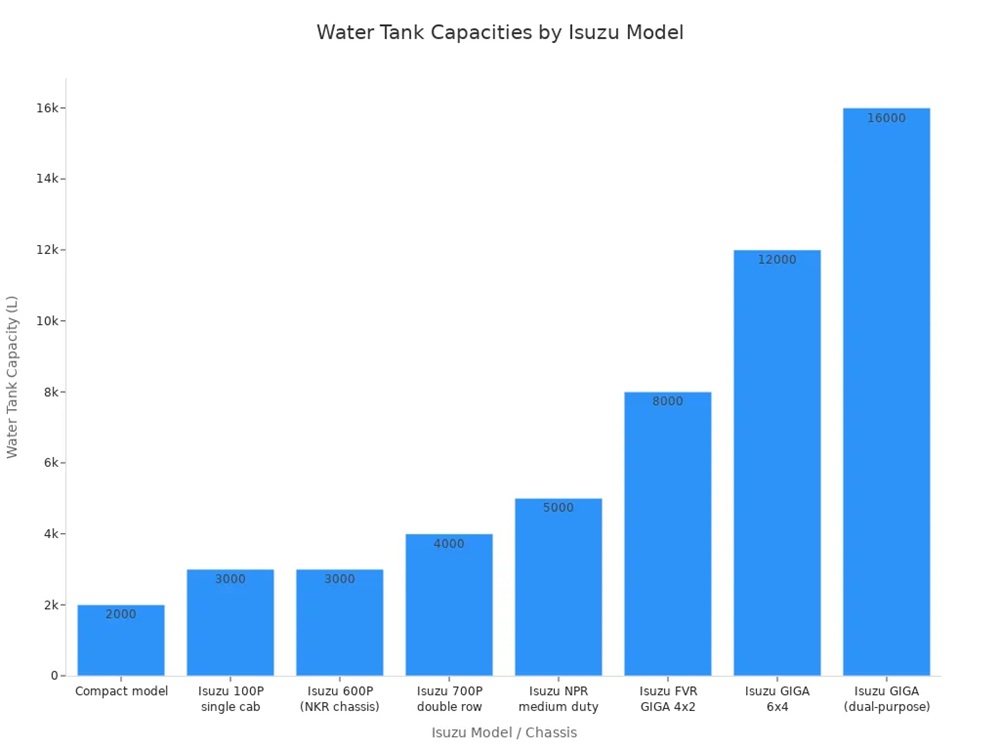
Water tank fire trucks with large water capacity are commonly used to spray water onto fires. Capacity and pump flow rate should match your district. A compact model may carry 2,000 liters with a CB10/30 pump and a PS20 monitor, while a dual-purpose GIGA build reaches 16,000 liters, and the largest single-tank configurations in the range carry 20,000 kg of water on a GIGA 8x4 chassis. The table below shows typical ISUZU water tank configurations.
|
Isuzu Model / Chassis |
Water Tank Capacity |
Fire Pump Model |
|
Isuzu 100P single cab |
3,000 L (3 m³) |
CB10/30 |
|
Isuzu 600P (NKR chassis) |
3,000 L stainless steel |
CB10/30 |
|
Isuzu 700P double row |
4,000 L (4 m³) 304 stainless steel |
CB10/40-RS |
|
Isuzu NPR medium duty |
5,000 L |
CB10/40 (Shanghai Xiongzhen) |
|
Isuzu FVR GIGA 4x2 |
8,000 kg |
CB10/40 medium/low pressure |
|
Isuzu GIGA 6x4 |
12,000 L carbon steel |
CB10/60 |
|
Isuzu GIGA (dual-purpose) |
16,000 L |
professional firefighting system |
|
Isuzu GIGA 8x4 |
20,000 kg carbon steel |
CB10/100 |
|
Compact model |
2,000 L |
CB10/30 |
A mid-range example shows how these numbers work in practice. An ISUZU FVR municipal fire tanker on a GIGA 4x2 chassis runs a 240 hp 6HK1-TCG61 engine, carries 8,000 kg of water, and pairs a CB10/40 medium/low-pressure pump with a roof-mounted PS8/40W monitor. That combination suits a town department that handles both building fires and roadside grass fires. The FVR build also runs a 4,500 mm wheelbase, a Fast 8-speed transmission, and a 2+3 cab, which keeps it inside the turning circles of most municipal streets.
One caution matters here. Water works well on Class A fires. Water is ineffective and potentially dangerous on Class B oil fires and Class C electrical fires. Train your crew to identify the fire class before they open the monitor.
Foam trucks answer the calls that water cannot handle. Fuel depots, chemical plants, refineries, and airports all store or move flammable liquids. A foam truck mixes concentrate with water and air, then blankets the burning surface.
The mechanism explains the fit. Foam floats on the burning liquid surface and forms a vapor barrier. This barrier smothers the fire and cuts off the fuel source, something plain water cannot achieve. Foam also lowers surface tension in structure fires, so the agent penetrates burning fuels faster than water alone. In rural areas with limited water access, foam extends the usable supply on the apparatus. Crews can even spray foam ahead of flames as a short-term barrier against wildfire spread.
|
Fire Scenario |
Why Foam Is More Effective |
|
Flammable liquid / hazardous vapor fires (Class B: alcohol, ether, oil, gasoline, grease) |
Foam floats on the burning liquid surface and forms a vapor barrier that smothers the fire and cuts off the fuel source, something plain water cannot achieve. |
|
Structure fires |
Foam concentrate mixed with water and compressed air lowers surface tension, letting the agent penetrate burning fuels faster and more efficiently than water alone, which largely runs off to the floor. |
|
Rural / wildland fires with limited water access |
Foam extends the usable water supply on the apparatus, so less water is needed to extinguish a fire, which is critical where hydrants or replenishment sources are unavailable. |
|
Pre-treatment / wildfire spread prevention |
Foam can be sprayed ahead of flames as a short-term barrier, coating terrain and materials to stop fire from spreading to nearby surfaces. |
Foam comes in two main families. Class A foam works like water and suits forest fires and structural work. Class B foam targets liquid spills and builds the vapor barrier that fuel fires demand. Specify the concentrate type around the fuels in your district. ISUZU chassis carry foam bodies well because the medium and heavy frames handle the tank, pump, and proportioning system without strain. The builds below show how the tank split scales with chassis class.
|
Build |
Water / Foam Tank |
Engine |
Pump / Monitor |
|
Isuzu 700P double row |
3,000 L carbon steel water + 1,000 L stainless steel foam |
4HK1-TCG61, 190 hp |
CB10/40-XZ |
|
Isuzu FTR 5 m³ |
4,000 L carbon steel water + 1,000 L stainless steel foam |
4HK1-TCG62, 225 hp |
CB10/30-RS |
|
Isuzu FTR 6 m³ |
5,000 L carbon steel water + 1,000 L stainless steel foam |
4HK1-TCG61, 205 hp |
CB10/40-XZ; PL8/32 monitor |
|
Isuzu GIGA 4x2 4.5 m³ |
4,000 L stainless steel water + 500 L foam |
6UZ1-TCG61, 380 hp |
CB10/60-RS; PL8/48 monitor |
|
Isuzu GIGA 6x4 12 m³ |
10,000 L carbon steel water + 2,000 L stainless steel foam |
6WG1-TCG62 |
CB10/140-XZ |
Two rules keep a foam build honest. Specify the proportioning ratio for the concentrate you will actually stock, because 3 percent and 6 percent concentrates do not share the same inductor setting. And size the foam tank around a single incident, not a week of calls, since concentrate has a shelf life and a half-empty tank is wasted money.
Dry powder trucks cover the third major hazard group. Flammable gases, liquid fuels, and energized electrical equipment all respond to dry chemical agents. Dry powder fire trucks, sometimes built as specialized petrochemical units, are preferred when dealing with flammable gases, liquids, or electrical equipment.
Dry chemicals come in variants. ABC powder suppresses all fire types and gives a department one versatile agent. BC powder targets gas and liquid fires specifically. Adding dry chemical powder to a water or foam solution helps on Class B fires. Industrial zones with high chemical or electrical risk often keep a dry powder unit on standby.
The range builds these as combined units rather than powder-only trucks, which is the practical choice for a small fleet. A GIGA 6x4 combined body carries an 8 m³ carbon steel water tank, a 2 m³ stainless steel foam tank, and a 3 m³ Q345R dry powder tank loaded with BC powder at 82 percent concentration, fed by nine nitrogen cylinders, with a CB10/80-LC pump, a PL8/64 roof monitor, a PF30 powder monitor reaching 35 m or more, and a powder gun good for 20 m. A lighter FVR version pairs a 4 m³ water tank with a 2,000 L powder tank on a CB10/40 pump delivering 40 L/s at 1 to 4 MPa. Both let one crew choose the agent at the scene instead of waiting for a second appliance.
Plan the cleanup routine before you buy. Dry chemicals are used sparingly because fine particulates spread widely and complicate cleanup. A dry powder truck fits best as a specialist unit in a fleet that already covers structure and liquid fires with water and foam.
Many departments in developing countries fight fires where no hydrant exists. Support trucks solve the water logistics problem. These units haul potable or non-potable water, refill attack trucks, and handle dust control and event supply between fires.
The ISUZU range covers this role from 5,000 L bowsers on a 100P chassis up to 20,000 and 25,000 L tankers on GIGA 6x4 and 8x4 chassis. Material choice follows the mission: 304-2B or SS316 stainless steel for drinking water, aluminum alloy or carbon steel for non-potable supply. Pump-in and pump-out capability, front, side, and rear spraying, and a rear water cannon turn a supply truck into a secondary firefighting asset.
|
Truck Model / Chassis |
Tank Capacity |
Tank Material |
Pump / Equipment |
Spraying / Functions |
|
Isuzu 100P (NKR chassis) |
5,000 L ellipse |
Carbon steel |
65QZF-40/50 pump; ultra-high-pressure washer |
Front spray, rear cleaning gun |
|
Isuzu KV100 (3,360 mm wheelbase) |
5,000 L (5 m³) |
Stainless steel |
65SQB-40/50L pump; three rear inlets; sight tube |
Potable delivery, pump in and out |
|
Isuzu 700P |
5,000 L |
304 stainless steel, 5 mm |
Stainless steel 40/50 pump, 40 m³/h |
Front, side, rear spraying |
|
Isuzu FTR GIGA 4X (4,500 mm wheelbase) |
8,000 to 10,000 L |
Carbon steel (galvanized square or oval) |
Weilong 80QZB-60/90N self-priming pump |
Front flush, rear spray, side spray, work platform |
|
Isuzu FVR GIGA 5X (4,500 mm wheelbase) |
10,000 L ellipse |
Carbon steel |
Portable fire pump set; high-pressure spray gun |
Front and rear nozzles, monitor |
|
Isuzu GIGA 6x4 sprinkler |
18,000 to 20,000 L |
Carbon steel, 5 mm |
Weilong 80QSB-60/90 or 80QZF-60/90S, 60 m³/h at 90 m head |
Front flush, rear cannon, side spray, spray width over 14 m |
|
Isuzu GIGA 6x4 drinking water |
20,000 L |
304-2B food-grade stainless steel |
Weilong 80QZBF-60/90N/S pump |
Potable delivery, rear cannon, reel sprinkler gun |
|
Isuzu GIGA 8x4 drinking water |
20,000 L |
304-2B stainless steel, 5 mm, square body |
Rear fire monitor; optional ROPS cage |
Urban supply, remote delivery, event supply |
|
Isuzu 8x4 water fire truck |
25,000 L |
Carbon steel |
Darley fire pump; Akron monitor |
Attack and shuttle duty in one unit |
A support truck pays for itself in shuttle operations. One large tanker can keep two attack trucks working at a fire scene far from any water source. Size the tank around the round-trip distance to the nearest fill point, and check that the fill point can actually deliver at a rate your pump can accept, because a 20,000 L tanker waiting on a 2-inch village connection is slower than three small bowsers working in rotation.
Height changes the response, but it changes it less than most buyers expect. The elevated appliance in this range is a 15m water tower fire truck, built for aerial working: a boom-mounted monitor fed from the tank, letting a crew put water onto a roofline, a warehouse ridge, or a market hall mezzanine without laying hose up a stairwell. For low-rise commercial streets, workshops, and two to four storey buildings, that reach covers the majority of calls.
|
Model / Reference |
Maximum Working Height |
Typical Applications |
|
Isuzu Water Tower Fire Truck |
15m |
Low-rise structure fires, warehouse and market halls, elevated monitor attack over obstructions |
|
Ground monitor on FVR or GIGA tanker |
Ground level only |
Yard fires, vehicle fires, spill fires, perimeter cooling |
Ground conditions decide whether any elevated appliance works for you. The outriggers need firm, level footing, and a 15 m boom still needs room to deploy. Check bridge limits, overhead cables, and narrow streets along the route before you commit to a long-wheelbase chassis.
Airfields carry a special risk profile. Aircraft fuel, dense passenger loads, and the need for rapid response off-runway all shape the truck specification. Airport rescue trucks combine water and foam in one vehicle so a single crew can knock down a fuel fire and keep the escape path wet while passengers evacuate.
This range builds two airfield configurations. The GIGA 6x4 airport rescue truck uses a 6UZ1-TCG61 380 hp engine with a Fast 12-speed transmission, a 2+4 double-row cab, and either an 8 m³ or a 10 m³ water tank with a 2 m³ foam tank, running a CB10/60 pump at 60 L/s and a PL8/48 monitor at 48 L/s. The GIGA 4x4 version carries 8,000 L of water with the same CB10/60 pump and a PS40W remote-controlled monitor, and its all-wheel drive keeps it moving on soft ground beside a runway.
|
Model |
Agent Load |
Pump / Monitor |
Drive and Crew |
|
Isuzu GIGA 6x4 airport rescue |
8,000 or 10,000 L water + 2,000 L foam |
CB10/60, 60 L/s; PL8/48, 48 L/s |
6x4, 2+4 cab, 380 hp |
|
Isuzu GIGA 4x4 airport fire truck |
8,000 L water + foam system |
CB10/60; PS40W remote monitor |
4x4, all-terrain response |
The agent load you are legally required to carry is not a brochure choice. Your civil aviation authority sets it from your aerodrome category, which is calculated from the critical aircraft using the field, and the requirement is expressed as a foam solution discharge rate and a minimum water quantity. Ask the authority for that figure in writing before you discuss body design. The two configurations above suit smaller categories and regional fields; a category that demands several thousand litres of water at a high discharge rate needs a purpose-built ARFF chassis with a larger foam system, which sits outside this range and should not be improvised from a tanker.
Confirm runway response times with the airport authority before you finalize the body design. Response time is measured from the alarm to agent application on the furthest runway point, and it constrains acceleration, top speed, and pump engagement more than tank size does.
Not every call involves flames. Vehicle crashes, building collapses, and medical emergencies fill a large share of modern call volumes. Rescue trucks carry the tools for these jobs.
Fire trucks carry hydraulic extrication equipment for rescuing people trapped in vehicles, buildings, or other structures. They also carry medical equipment and supplies for emergency medical services. Firefighters often train as EMTs, so the truck becomes a first-response medical unit as well.
A typical rescue body carries:
ISUZU medium chassis suit rescue bodies well. An FTR rescue vehicle runs a 4HK1-TCG62 225 hp engine with a Fast 8-speed transmission, a Champion N16800XF electric winch at the front, an all-aluminum equipment rack, a 10 kW Honda generator, and a lighting mast that raises 7 m. The FVR version steps up to a 6HK1-TCG61 240 hp engine, a 10.5 kW Honda GX630 generator, an 8 m mast, and four 1,000 W lamps on an electrical control system. Both keep the frame length free for a walk-in or non-walk-in body, and the cab options cover crew seating needs. Plan the equipment layout around your most common extrication scenario.
Prevention saves more lives than response. A publicity vehicle brings fire safety education to schools, markets, and villages, and the practical way to build one on this range is the FVR or FTR mobile stage truck. These units carry a box body that opens into a hydraulic fold-out stage with its own outriggers, an LED display face, and storage for printed material and demonstration gear.
The body design stays simple. Shelving holds leaflets and teaching kits, the stage supports live extinguisher demonstrations, and the display runs safety films after dark when a market square is still busy. Some departments mount a small water tank and a monitor so a crew can run a live extinguisher drill on site instead of talking about one.
Budget this unit as a prevention asset. A visible, well-equipped education truck builds community trust and reduces careless-fire incidents over time, and it doubles as a command or briefing point during long incidents, which is how most departments justify the spend.
Truck type tells you what the vehicle does. Truck size tells you whether it can do that job on your roads. Body volume and payload set the chassis class. ISUZU organizes this decision around three chassis families: the N-Series for light duty, the F-Series for medium duty, and the Giga for heavy duty. Each family carries a different ceiling for tank size, equipment weight, and crew space. Pick the smallest chassis that meets your load, then verify it against the terrain.
The N-Series covers the light end of the ISUZU lineup. These chassis suit fast attack work in narrow streets, dense markets, and rural tracks. A light truck turns in tight spaces, crosses light bridges, and burns less fuel on short runs.
Typical N-Series fire bodies include:
The 100P, 600P, and 700P models appear most often in this class. A 600P on the NKR chassis measures 6,220 x 1,960 x 2,840 mm, runs a 120 hp engine on 7.00R16 tires, and carries a 3,000 L stainless steel tank with a CB10/30 pump and a PS8/20W monitor in a five-seat double-row cab. A 700P double-row cab carries a crew of six with a 4,000 L stainless steel tank and a CB10/40-RS pump. That package handles a village or small-town district well. The N-Series also fits departments that answer many small calls and few large ones. Size the tank around your typical call, not your worst-case call. A light truck that arrives fast beats a heavy truck that arrives late.
Check the gross vehicle weight rating before you finalize the body. Tank, water, pump, hose, and crew all count against that number. Leave margin for equipment you plan to add later.
Some districts have streets that no truck above 3.5 tonnes can enter. For those, the range includes a 4x4 fire rapid intervention pickup built on the ISUZU D-MAX off-road chassis, with a 1.9T RZ4E diesel producing 143 hp and 410 Nm through a ZF 8-speed automatic. It carries a 500 L water tank with an integrated high-pressure pump good for more than 30 m of throw, rides on 230 mm of ground clearance with a 28 degree approach angle and a 25 degree departure angle, and needs no hydrant to start work.
Treat this unit as a first-attack appliance, not a tanker. Five hundred litres buys you the two or three minutes that decide whether a kitchen fire stays in the kitchen, and the pickup gets there through a market alley or an unpaved lane that would stop an FVR. Departments that buy one usually pair it with a support tanker that follows the same route a few minutes behind.
The F-Series sits in the middle of the ISUZU range. These chassis carry more water, more equipment, and more crew than the N-Series without the cost and road limits of a heavy truck. Medium duty suits municipal departments that cover both structure fires and fuel hazards.
The FVR and FTR models anchor this class. An FVR GIGA 4x2 water tanker carries 8,000 kg of water with a CB10/40 medium/low-pressure pump and a roof-mounted PS8/40W monitor. An FTR GIGA 4x2 support truck carries 8,000 to 10,000 L of water in a carbon steel tank with a Weilong 80QZB-60/90N self-priming pump, front flush, rear spray, and side spray. An FVR GIGA 5X version runs a 10,000 L elliptical tank with a portable fire pump set and a high-pressure gun, which covers town supply, dust control, and secondary firefighting from one chassis.
Medium chassis also accept foam systems and combination bodies. The frame length gives body builders room for a pump compartment, a foam proportioner, and hose storage. Crew cabs in this class seat five to six firefighters in full gear, typically 2+3 or 3+3. Choose the F-Series when your call mix includes fuel depots, warehouses, and mid-rise buildings. The medium chassis balances capability against the road network most developing-country towns actually have.
The Giga chassis carries the largest ISUZU fire bodies. Heavy duty makes sense when you need high water volume, multi-agent capability, or long pump runs. These trucks anchor a fleet and handle the calls that overwhelm light and medium units.
The Giga 6x4 platform supports combined water, foam, and dry powder bodies. One configuration pairs a 6UZ1-TCG61 engine rated at 380 hp with a top speed of 100 km/h. The payload combines an 8,000 L water tank, a 4,000 L foam tank, and a 3,000 L dry powder tank. A CB10/100 fire pump, a PLKD80 monitor, and a QGH-5 dry powder gun complete the package. That single truck answers Class A, Class B, and Class C calls without a second appliance.
|
Variant |
Chassis / Drive |
Engine |
Tank Capacities |
Pump / Monitor |
|
GIGA 6x4 water/foam/dry powder |
GIGA 6x4 |
6UZ1-TCG61, 380 hp (max 100 km/h) |
8,000 L water + 4,000 L foam + 3,000 L dry powder |
CB10/100 fire pump; PLKD80 monitor; QGH-5 dry powder gun |
|
GIGA 6x4 foam fire truck |
VC61 6x4, 4600+1370 mm wheelbase |
6UZ1-TCG61, 380 hp; Fast 12-speed gearbox |
8 m³ carbon steel water + 2 m³ stainless steel foam |
CB10/60 fire pump; PL8/48 water-foam dual-purpose monitor |
|
GIGA 4x2 foam water fire truck |
GIGA 4x2, 4500 mm wheelbase, 2+3 seats |
6UZ1-TCG61, 380 hp, Euro 6, 9839 ml; Fast 12-speed gearbox |
6 m³ carbon steel water + 2 m³ stainless steel foam |
CB10/60 fire pump; PL8/48 monitor |
|
GIGA 8x4 water/foam tender |
GIGA 8x4, 1850+4575+1370 mm wheelbase |
6WG1-TCG62, 520 hp |
20,000 kg water + 4,000 kg foam concentrate |
CB10/100 fire pump, 100 L/s; PL8/64 monitor |
The Giga 4x2 variant gives smaller departments a middle path. It carries 6 m³ of water and 2 m³ of foam on a 4,500 mm wheelbase with a Euro 6 engine and a 12-speed gearbox. That footprint fits municipal streets better than a 6x4, and the foam capacity still covers a fuel depot or a highway spill. If your risk is bulk water rather than agent variety, the 8x4 tender carries 20,000 kg of water and 4,000 kg of foam on one chassis, and 25,000 L single-tank builds are available on the same platform with Darley or comparable pump sets.
Heavy trucks demand more from the operator. They need wider turning circles, stronger bridges, and trained drivers. Budget for those requirements before you order. A Giga that cannot reach the fire scene adds nothing to your response.
The chassis decision fails when the road network cannot support it. Run a route survey before you sign the order. Drive the roads your department actually uses, not the roads on the map.
Check these items on every route:
Water supply shapes tank size as much as terrain does. A department with reliable hydrants can run a smaller tank and rely on refill speed. A department with no hydrants needs a larger tank or a support truck to shuttle water. Match the tank to the round-trip distance to your fill point. A 20,000 L tanker that spends two hours refilling at a low-yield connection serves the scene worse than a 10,000 L tanker that returns in thirty minutes.
Local regulations close the loop. Some countries cap axle loads or overall vehicle dimensions on public roads. Registration rules may restrict chassis class by license category. Confirm these limits with your transport authority before you finalize the specification. The ISUZU range offers enough chassis options that a compliant configuration almost always exists. The survey simply tells you which one to order.
The chassis and body choice sets your capability. The supplier decides whether that capability holds up over ten years of service. Choose an Isuzu Fire Truck Supplier with fire-body experience, not just general truck sales.
The sticker price tells you little. Add up fuel, tires, pump servicing, body repairs, and downtime across the truck's service life. A cheaper unit with a weak pump or thin tank steel costs more per year. Ask each Isuzu Fire Truck Supplier for a written lifetime cost estimate. Compare pump brands, tank materials, and warranty terms side by side. A higher purchase price often pays back through fewer breakdowns and longer service intervals.
Fire codes vary by country and city. Pump output, tank size, warning lights, and crew seating may all carry legal minimums. Registration rules add axle-load limits and license categories. Send your draft specification to the fire authority and the transport office early. A good Isuzu Fire Truck Supplier knows these local requirements and can adjust the body design before production starts. Fixing a compliance problem after delivery costs far more than fixing it on paper.
Downtime kills fire readiness. ISUZU maintains a broad worldwide support network for prompt maintenance, repair, and spare parts supply, which helps departments keep vehicles in service. Confirm the nearest authorized service point and the typical lead time for common parts. Ask about driver training and pump operator courses. Build a spare-parts stock list for filters, belts, hoses, and pump seals. A reliable Isuzu Fire Truck Supplier supports you after delivery, not just at the signing.
Match the truck type to your fire scenario. Match the truck size to load, terrain, and water supply. Confirm your budget, local regulations, and service support with a reliable Isuzu Fire Truck Supplier before you order. Finally, check your specification against your department's most common call types and the roads the truck will actually drive.
Choose a water tank truck on an N-Series or F-Series chassis. Add a support tanker for water shuttle duty. Size the tank around the round-trip distance to your nearest fill point, and check that the fill point can deliver at a rate your pump can accept.
Match the chassis to your roads and call volume. Light trucks reach narrow streets fast. Heavy Giga trucks carry multi-agent bodies for fuel depots and large industrial sites, up to a 20,000 kg water and 4,000 kg foam tender on an 8x4 chassis.
Confirm local fire code compliance, axle-load limits, and registration rules. Ask for a lifetime cost estimate. Verify parts lead times and driver training support in writing.
Crew seating across the range tops out at six. Light and medium cab options are usually 2+3 or 3+3, and the GIGA airport rescue unit uses a 2+4 layout. Plan shift changes and breathing apparatus stowage against that six-seat ceiling rather than against a larger figure in a brochure.