1. Introduction to portable fire pump structure
JBQ 4.5/9 portable fire pump consists of engine, water pump body, water diversion device, water diversion valve, water outlet valve, hand lift, fuel tank, battery, muffler, operation panel, water pilot handle, etc. The main structure is shown in Figure 1.

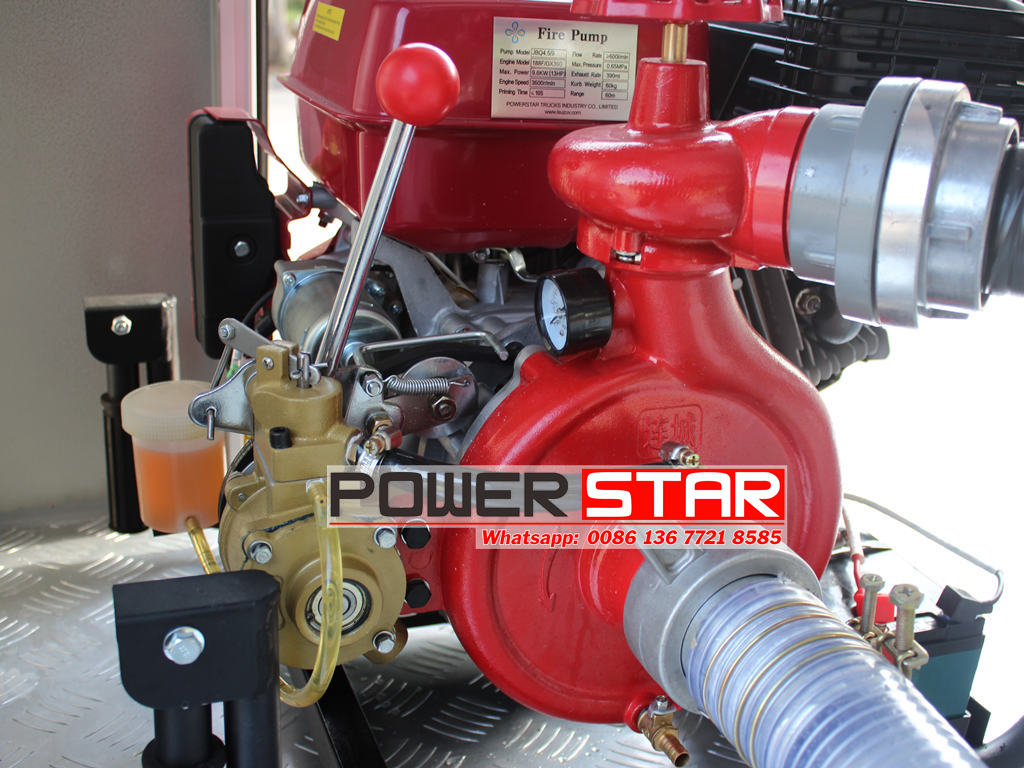
2. Operation method of JBQ4.5/9 fire pump
1) Preparation work
a. Filling enough gasoline, be careful not to fill it too full to avoid overflow. Make sure to tighten the fuel tank cap after adding enough gasoline.
b. Check whether the sealing gasket is intact, install the water inlet pipe, and tighten the water inlet pipe joint by hand to prevent air leakage.
c. The filter of the water inlet pipe should be placed in a clean water area as much as possible, and at a certain distance from the bottom and water wall: if there are many sludge and weeds in the water source, the filter should be placed in a basket and put into the water together. The bend of the water inlet pipe should not be higher than the water inlet of the water pump to avoid difficulty in absorbing water.
d. Install the water outlet pipe and water gun
e. Pay attention to safety inspections, remove flammable and explosive items near the fire pump, and non-operators are not allowed to surround the equipment.

2) Starting program
a Turn on the black throttle switch on the carburetor
b Adjust the position of the white damper switch according to the temperature.
c Adjust the throttle switch to the middle position
d Turn the electric start switch to the ON position
e To start with your right hand, step firmly on the frame of the fire pump with your right foot, hold the starting pull handle tightly with both hands, and slowly pull out a section. After receiving the force, quickly pull out the remaining rope in the tangential direction to start the gasoline engine.
Notice:
The electric start should not take more than 4-5 seconds each time to prevent burning out the starter motor. If it cannot start at one time, it can be repeated several times and the position of the damper should be slightly adjusted.
f After starting, adjust the damper to the ON position
g Adjust the throttle handle to make the gasoline engine run stably.

3) water diversion operation
a Close the small waterproof valve of the water pump.
b Move the handle of the vacuum pump with your hand to make the belt drive the vacuum pump to rotate and discharge the air in the water inlet pipe.
c. After the water flow at the outlet is continuous, release the vacuum pump handle and let the vacuum pump stop working.
4) shutdown procedures
a Turn down the throttle.
b Turn the black throttle switch on the carburetor to the OFF position
e When the engine has finished burning the gasoline in the carburetor and stops automatically, turn off the key switch, open the drain valve to drain out the remaining water in the pump.

3. Precautions for use of JBQ4.5/9 fire pump
1) During the initial use of a new engine, in order to ensure good running-in of all parts of the entire engine, the gasoline engine should be run at medium speed for 25 hours before being put into full load operation. To reduce failures and increase the service life of gasoline engines. In case of fire extinguishing, there are no restrictions.
2) Only operate at maximum power once every three hours. Never exceed this limit when using
3) It is strictly forbidden to run the water pump dry for a long time without water in it to prevent the oil seal from being burned. If the water cannot be diverted for a long time, the cause should be checked and the fault should be eliminated before diverting water again. If you need to observe whether the engine is running normally for a longer period of time and during normal training exercises, you should add a small amount of
4) After using corrosive water sources such as sea water, hot spring water or other sewage, use clean water to run the pump for 3-5 minutes to flush the residual water inside the pump to avoid corrosion of the mechanical parts.
5) The hand-held mobile fire pump needs to be tested regularly (once a week) and run with load. At the same time, pay attention to whether the gasoline engine is running smoothly and whether there is any oil leakage, so as to eliminate it in time. 6 When the hand-held mobile fire pump is not used for a long time, it should be Drain the gasoline in the fuel tank and carburetor; drain out the water in the water pump, then install a protective cover and store it in a ventilated and dry place.
4. JBQ4.5/9 fire pump maintenance
The maintenance of hand-held mobile fire pumps is a very important task, which is of great significance to extending their life and ensuring their effectiveness.
1) Routine maintenance
The product must be kept clean and intact. External dust and oil should be removed after each use or exercise, check whether the parts are complete, whether the connection parts are tight, and repair them at any time. Always check whether the oil in the crankcase is standard. If the oil quantity is insufficient or the oil quality is poor, the crankshaft, connecting rod, piston, valve and other parts of the gasoline engine will be seriously worn and may cause a major accident. Special attention should be paid to this point .
Do not bend the water inlet pipe excessively or place heavy objects on it to avoid breaking or crushing it. The sealing gasket in the water inlet pipe joint must not be damaged or dropped, otherwise it will be difficult or even impossible to divert water.
Troubleshoot discovered faults in a timely manner to keep equipment operating normally
2) Maintain equipment
Drain the old oil in the crankcase, and then add enough clean oil (the oil needs to be replaced 20-25 hours after leaving the factory, and every 50 hours thereafter).
Remove carbon deposits from spark plugs. Clean the fuel tank and oil filter cup, unscrew the lower screw plug of the carburetor, and remove the sediment.
Open the air filter cover and take out the filter element. If you find that the filter element is dirty, replace it immediately.
Note : Remember not to start the gasoline engine without a filter element.
Remove the windshield, check whether the gap between the two stages of the flywheel magnet and the integrated high-voltage package is about 0.35mm, check whether the two bolts fixing the high-voltage package are tightened, and check whether the start switch wire is connected reliably.
Remove the muffler tailpipe nozzle and brush and clean the carbon deposits.
Check whether the wires between the battery, starter motor, voltage regulator and switch are loose or damaged, and whether the insulation is good.